Showing posts with label Adam Art Gallery. Show all posts

Tuesday, 20 October 2015

Andrew Beck: Before the Afterimage

by Ashleigh Hutchinson

CAUTION: AFTER IMAGE MAY CAUSE CONFUSION, WONDERMENT, AND A GENERAL QUESTIONING OF THE REALITY OF THE WORLD AROUND YOU. 
Andrew Beck is an Auckland based artist who has exhibited his work in New Zealand as well as Tokyo, Melbourne and Berlin. What began as a study of photography at Massey University of Wellington transformed into an exploration of the creation of photographs without a camera. This may sound like a fool’s errand, but photography has its roots in the method. Early developments in photography by scientist Anna Atkins for example, with the Cyanotype (fig.1) or more famously Lace (fig. 2) by William Henry Fox Talbot, saw the use of photosensitive paper that reacted with light when exposed. Read Lucy Jackson’s Adam Art Gallery Seminar Series: ‘In Absentia: The Politics of Cameraless Photography’ by Geoffrey Batchen for a more detailed discussion about the medium. What Beck has done is utilised this technique in his rhetoric about the use of space and its interaction with light. His installation in the Adam Art Gallery entitled After Image is part of a larger exhibition The Specious Present, which consists of four artists whose work visually articulates William James concept of the ‘specious present’. It denotes a period of time that is longer than the present moment but that exists between the past and the future.
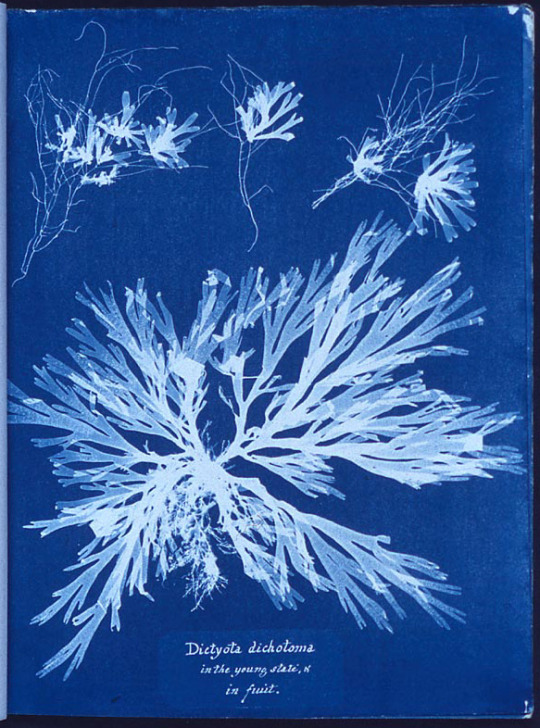


Fig. 1
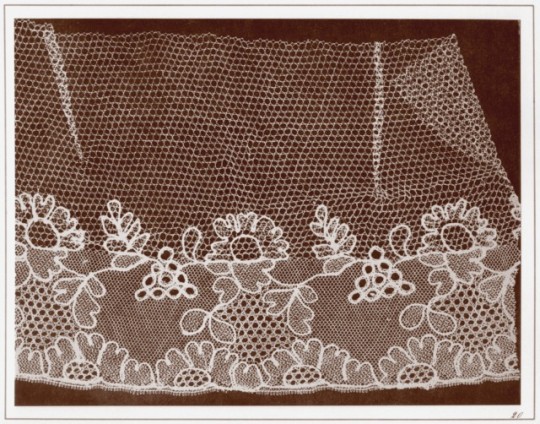


Fig. 2
When I first saw Beck’s pieces at the exhibition, I was immediately enthralled, intrigued, and a little more than confused.  He had created objects of indeterminate origin, undetectable technique and interesting form. To quote the Greek philosopher Socrates – ‘I am wise because I know one thing, that I know nothing’. I was flummoxed. What was obvious however was that Beck was playing off the light and space of the gallery itself. An innate understanding that your experience of a piece such as Linear Split (8 phases) (fig. 3), depended on your understanding of light and corresponding shadows and the way these were cast within the gallery space was obvious. Beck achieves through his work a sense of spatial awareness both in the viewer but also of the objects themselves. Shadow Strips Cascade (fig. 4) for example is a site specific piece that relies on the strip of light contributed by the architecture of the gallery itself, each photogram is made to look like a reaction to the piece directly before it. To create these Beck would place a piece of paper overtop of another light sensitive piece and with exposure to light would cause the white silhouette to remain. This to me is the epitome of the ‘specious present’ by which the cascade represents a continuous reaction to the light of the gallery space that means the artwork remains in a constant state of stasis.
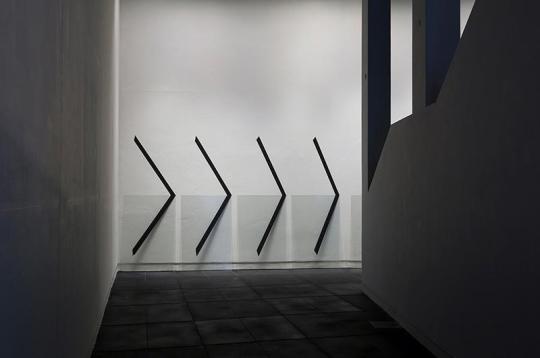


Fig. 3
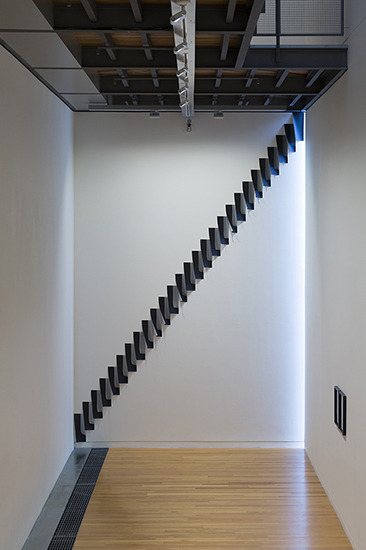


Fig. 4
Beck’s artwork itself exists in an in-between, and is a play on the duality of being, in that it becomes both photograph and painting, object and shadow, natural and manmade. As I stood in front of his work Linear Split (8 phases) my friend pointed out to me that she couldn’t decide whether the shadows projected by the glass were painted on or were in fact real shadows cast by the installation. We proceeded to spend a further ten minutes inspecting the shadows and still coming to no conclusion. Beck’s body of work intentionally plays on the exhibition space itself, causing you to question the validity of the term ‘unusable space’, what is gallery and what is installation, what is real and what is manufactured. An exhibition of Beck’s at the Galerie Luis Campaña utilised paint to create Invariant Shadow (fig. 5) which saw an abstraction of the idea of the realistic shadows that have previously plagued his work, to develop into a question surrounding the credibility of the work itself. The space, previously written-off as unusable in a gallery context, is transformed into a work of art through manipulation of our understanding of light sources, cast shadows and gallery space.


Fig. 5
Some of Beck’s earlier works betray the scientific facet of the medium’s ancestry. 11.35-11.55am (light drawing) (fig. 6), required knowledge of light patterns in situ at the Hamish McKay Gallery in Wellington. The abstract sundial (fig. 7) in the open window at the Govett-Brewster in New Plymouth was also time and light reliant, and echoes the use of the cyanotype by Atkins for documentary purposes rather than artistic. This piece represents a specific time of day that Beck has transformed into a continuous moment, the shadow of which is painted in black as cast by a metal rod. The metal rod embodies the ubiquitous nature of objects, by which the rod is industrial but has now been transformed into ornamental. These earlier works stand to show the development of Beck’s work from studying sources of light in relation to time, to involving space and creating philosophical, abstract objects of modernity.
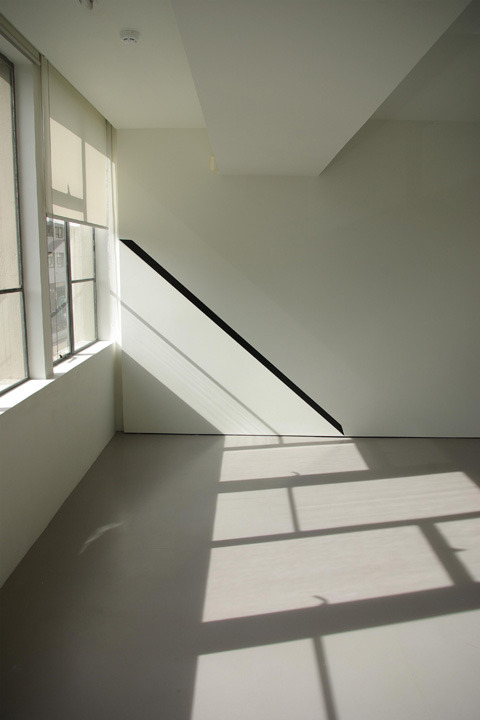


Fig. 6
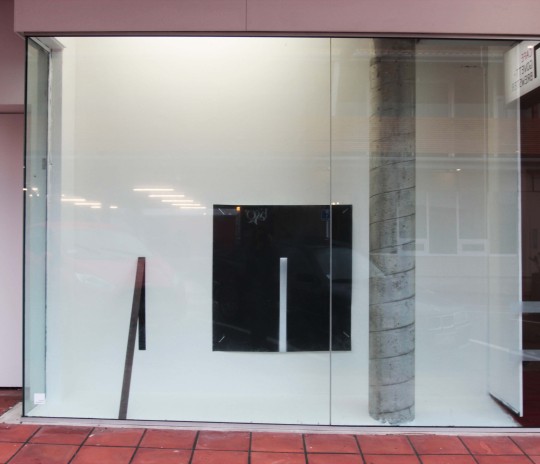


Fig. 7

When filtered through the medium of photography again, Beck’s images transform to inhibit another dimension. A dimension that is becoming more prevalent in a world of technology and social media, and the availability of that technology which encourages the institution of the snapshot photograph. The reflective surfaces of such intriguing photograms invite the viewer to use their own cameras to capture an image of the pieces such as Descending Platforms (fig. 8). The resulting photograph involves the viewer, who has thus been transformed into the object, as a representation of themselves is merged with the image of Beck’s. The viewer now also occupies the space of the image, meaning that in a way the viewer has come full circle in not just observing visual representations of the specious present, but becoming a part of it. 

Fig. 8


Wednesday, 16 September 2015

Walk

by Eleanor Lee-Duncan

If you haven’t yet seen this work, head into the Adam Art Gallery before this exhibition finishes (this Sunday the 20th!) to check it out.


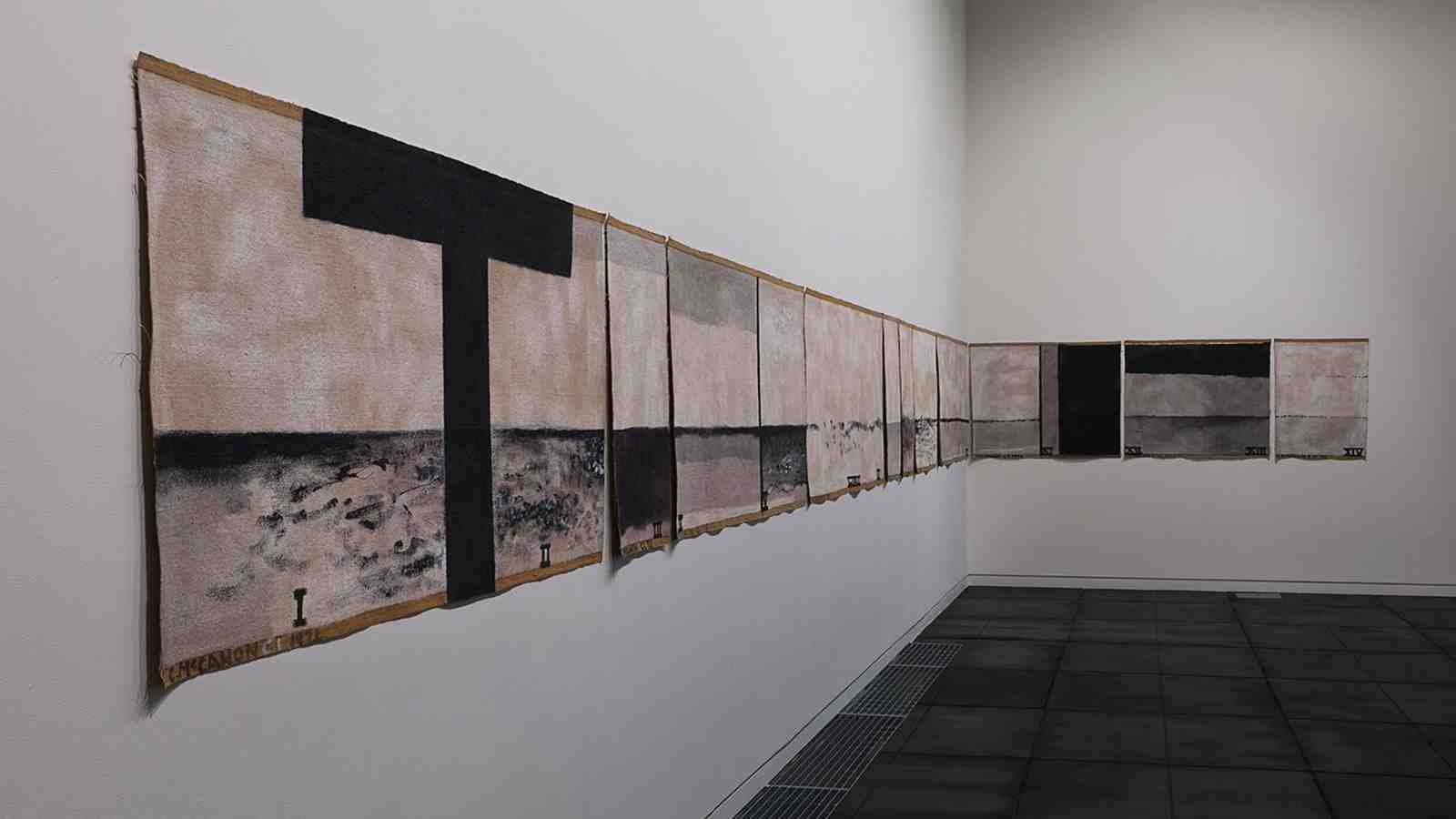
Colin McCahon, Walk (Series C) 1973, synthetic polymer paint on unstretched jute canvas, 11 panels. Collection of Museum of New Zealand Te Papa Tongarewa (photo: Shaun Waugh)

Walk (Series C), painted in 1973 is a monumental work by Colin McCahon, and seldom seen, since its purchase in recent years from a private collection by Te Papa, who graciously have loaned it to the Adam. Monochromatric, and disarming in size, it is neatly divided into 11 pieces, almost all linked by a single flowing horizon line of the sea. Hung at eye level, it keeps pace with me as I pause on each panel to contemplate. Am I keeping in step with Colin McCahon as he walked alongside this work mindfully, after each panel was complete? Did his eyes drift, slow, and then come to a still to inspect the same minute, scuffings of brush marks, and canvas threads unwinding on the edges? My eyes glide along the morse-code short and long dashes of the horizon line. 

We can view this painting as consisting of four layers of journeys or walks, which have been conceptually layered and co-exist.
The first: When we view this work, we, the viewer are compelled to walk from end to end of it in order to examine the whole work. This walk is our own journey of experiencing the painting, and keeps pace with our mental or emotional experience of the work.

The second: In doing so, we fall into step with McCahon’s own physical journey along Muriwai beach –  although in different temporal and spatial boundaries – open to the different sensory and emotive experiences of the wind, the sand, the water, the saliferous smell of the sea. After his friend James K. Baxter’s death in 1972, McCahon painted this work as an homage to the poet, perhaps thinking of him as he walked along the beach. Here, he has recorded the seascape, with the water and sky divided by a continuous thin line. McCahon reproduces this experience in his painting, walking alongside the strips of canvas while dabbing and dashing different dividing lines of land, sea, sky. Captured in different possible weather conditions, some are misty, hazy views while some are sharp, and clearly delineated.


image: www.mccahon.co.nz

The third: The walk of Christ to his execution, and the moments leading up to, and following his death. The canvas is marked with the Roman numerals 1-14, signifying the 14 Christian ‘Stations of the Cross’ – a reflective journey some people undertake around Easter, following different art works in physical spaces, or symbolic or literary anchor points in order to contemplate each experience that Jesus may have gone through. For example, the first panel has the numerals ‘I’ and ‘II’ inscribed, divided by a thick black ‘T’ of a cross. These two stations are traditionally held to be Jesus sentenced to death by crucifixion, and Jesus picking up the cross to carry it up the hill to his death. Here, the ‘T’ cross marks both the imminent method of execution, and the physical strain of the beginning of Jesus’ walk, carrying the physical weight of the instrument of his death. The only other thick black vertical section McCahon has painted is number 11, Jesus being nailed to the cross. This heavy, driving downward line brings to mind the exertion of nails being driven through Christ’s flesh to affix him to the wood. It is followed by three stacked sections of thicker grey paint, the top section black, for the panel representing the 12th and 13th stations: Jesus’ death and deposition from the cross. ‘Reading’ this panel, our eye drags downward on this canvas from the darkest stripe at the top, effectively mirroring the downward pulling of Jesus’ body from the cross.
The fourth: The spiritual journey to the afterlife of deceased Māori souls, up the West coast of Aotearoa New Zealand, past Muriwai beach and onto the sacred site of Cape Reinga, where they depart from the ancient pohutukawa tree. There, they travel down the overhanging roots of the tree, into the ocean. The spirit would surface briefly at Manawatawai (Three Kings Island) to take a final look at the landscape, occupied by the living, before continuing on to the next world. McCahon’s end panel, painted white, has a faint tracing of a line in the sky, floating parallel to the sea – perhaps a spirit taking its last journey.

Friday, 24 July 2015

Word of the week

Art vocab to impress your friends

by Eleanor Lee-Duncan

Chiaroscuro “key-are-oh-skur-oh”

‘(Ital. light-dark). As generally used, chiaroscuro (or the French clair-obscur) means the balance of light and shadow in a picture, and the skill shown by the painter in the management of shadows.’
                                        -The Penguin Dictionary of Art and Artists
In other words, when we look at an image, whether a painting, photograph, film still, drawing, or engraving and can clearly see an interplay between areas of light and darkness, we are looking at chiaroscuro. This can be used as soft, smoky blended areas to create a sense of subtle three-dimensionality, or it can be used boldly in clear, crisp areas of light and shadow which contrast within an image to create a sense of dynamism or drama. Sometimes chiaroscuro is used to highlight or bring attention to a certain area or aspect of a work.
The current exhibition at the Adam Art Gallery, called The Specious Present, is fairly monochromatic: most artists limit themselves to shades of white and black in the works displayed.
Image credit: Adam Art Gallery 
For example, in this work by Colin McCahon, currently on display at the Adam Art Gallery, titled Walk (Series C), we can see that McCahon has used different gradients of painted shade in each strip of canvas. In the first panel on the left, McCahon has used chiaroscuro to create a jet black, vivid ‘T’ shaped cross, which cuts down through the entire composition with force. The ‘T’ stands out especially because the horizon line which intersects it is lighter as it gets closer on either side. Because of this, the lower half of the ‘T’ seems to stand out more – this is because the fading horizon line behind it emphasizes it, and seems to push the ‘T’ towards us.
Image credit: caravaggio.org


In a more traditional sense, chiaroscuro is used in art history to refer to this interplay between light and shadow especially in Baroque art, for example in Caravaggio’s paintings. Like his painting above, Judith beheading Holofernes, Caravaggio uses chiaroscuro as a strong compositional device. He has used bright, harsh light on the three figures which contrasts with dark areas, defining the muscular contortions of Holofernes as he dies. Judith in the centre seems to radiate with this light, which illuminates her face and collar. Also, you can see that the shadows in the background are incredibly dark, making the figures appear like spot lit actors frozen in a film noir scene.

Wednesday, 15 July 2015

Here and There and Nowhere


by Simon Gennard
The Specious Present, Adam Art Gallery

11 July - 20 September 2015

Surveillance Awareness Bureau, 1 Grey Street

27 May - 13 June 2015


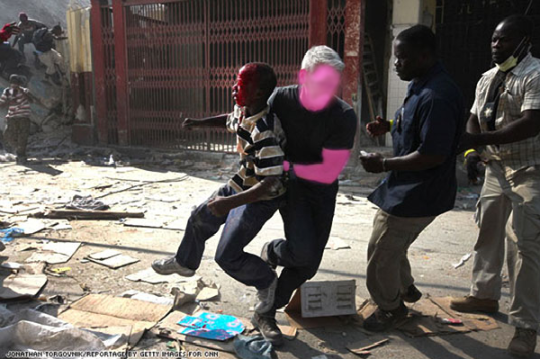
Before Anderson Cooper came out, before he confirmed what everyone already knew about him, a photo of the journalist carrying a Haitian child to safety during looting following the 2010 earthquake made the rounds on Tumblr. The photo was accompanied by a long, impassioned comment. I can’t remember it verbatim, and I can’t find this particular post, but I do remember the image being used as evidence for the sturdy and compassionate moral fibre of homosexuals everywhere.
It’s kind of inane, as arguments go, but I’ve been thinking about it recently (as if Anderson Cooper were not eternally in our hearts and dreams) after reading Nicholas de Villiers’ ’Afterthoughts on Queer Opacity’. In the essay, de Villiers muses on what queer visibility means now. It can be read as a kind of addendum to his book Opacity and the Closet: Queer Tactics in Foucault, Barthes, and Warhol. De Villiers is interested in the kind of mechanisms developed by these figures to evade demands to ‘come out,’ to attach themselves to a politics of queer representation and exceptionalism that now seems inescapable. He writes:
Rather than seeing Foucault, Barthes, or Warhol’s 'opacity’ as symptomatic of 'the closet’ and internalized homophobia—where opacity would be merely a reactive desire for 'privacy’ that is ultimately complicit with homophobia and repressive silence—I was interested in their tactical negotiation of their public personas in interviews and published texts where they are visible, but opaque (not 'see-through’ or easily deciphered).
De Villiers’ essay is an attempt to discuss this evasion outside of the queer canon. He applies his arguments to Cooper, Jodie Foster, Queen Latifah, Ellen Page, and Lana Wachowski. Escaping the canon, I guess, takes baby steps. De Villiers’ draws a direct route between the necessity for queer public figures to come out, to be visible and transparent, to perform as brave and worthy examples for queer youth to follow, a la Cooper’s act of heroism, and the project of legal recognition that governs the discourse of mainstream queer rights - marriage equality, equal access to serving in the military. The same state towards whom these demands are made relies on visibility, on recognition, in another, fundamentally more sinister, way. The state relies on surveillance technologies - on its subjects being seen and known - to police movement, to combat displays of collective resistance, to criminalise individuals who belong to certain racial, cultural, class groups.
I suppose I am thinking about Anderson Cooper saving that Haitian child because the argument that accompanied the image posited, implicitly, queerness as a moral deficit, and public, documented acts of compassion such as this one as a necessary reparation to be made before the state is able to recognise queer subjectivities. It implies, further, that the aspirational good life for queer subjects is one necessarily comprised of these reparative acts; that to be a good queer citizen is to embody this kind of decentness, to be married, to be loyal to the point of being willing to go to war. This discourse obfuscates that these reparative acts seem to be so easily ascribed to the bodies which are pale, ruggedly handsome, beefy-forearmed, unquestionably and quite comfortably masculine. As for bodies which refuse to comply with this model?They might be lucky to appear as a footnote.
De Villiers ends his essay by discussing Zach Blas’ ongoing project, Facial Weaponization Suite, a video from which was included in the Surveillance Awareness Bureau exhibition held on Grey St last month (the video is also available on his website). Blas’ video takes as its point of departure the rapid embrace of facial recognition and biometric technologies by state security operations, as well as advertisers hoping to cater content according to normative categories of gender, race, and class. The video then turns its attention to a recent study published in the Journal of Experimental Social Psychology which suggested people are able to distinguish between heterosexual and homosexual men based on photos of their faces, even when exposed to the photos for only half a second. The video’s call to arms is somewhat facetious, and incredibly important. The question at the heart of the video, 'How do we flee this visibility into the fog of a queerness that refuses to be recognised?,’ takes its cue, maybe somewhat ironically, from the Guy Fawkes mask adopted by Anonymous. The video calls on queer citizens to don a 'fag face’ - a pink mask, said to be a distorted amalgamation of faces that 'cannot be read or parsed’ - as a means of binding citizens into a shared project of resistance. It treats invisibility not as suppression - in the way that a closet might - but as a weapon.
I want to think about what images surface as a result of this widespread embrace of surveillance technologies. I want to think about these images as the result of an ongoing attempt to see and be seen from all angles. I want to think about how we learn to read these images, and in particular what omnipotent vision does to a sense of time. How it can protract a single moment. How it can efface everything before and after and call itself whole. I like to think of the work of David Claerbout, whose presentation The Quiet Shore is currently on display at Adam Art Gallery as part of their exhibition The Specious Present, as the manipulated detritus left over from seeing too much of a scene. Writing on The Algiers’ Section of a Happy Moment, a 32 minute slide presentation detailing the instant a football game is interrupted by a flock of seagulls from every angle imaginable, Claerbout places this work within a project of examining the 'suspicious gaze.’ In some ways, Claerbout’s work avoids an association with what we might think of as surveillance imagery, through the deployment of crisp, heavy contrasts, a welcome rhythm between the close-up and the distant. These poetic elements only serve to make the work more hypnotising.
There’s an odd kinship between Claerbout’s and Blas’ work. It might not seem immediately obvious; Blas’ intervention is directed towards a particular public whose historical relationship with seeing and being seen is being renegotiated in a very particular way. Both artists redeploy the mechanisms of surveillance, but where Blas relies on irony and recruitment, Claerbout opts for the kind of dullness granted by holding one’s gaze for too long, and in doing so illuminates the inadequacy of dense masses on images in revealing nuance. It’s not an intimacy, so much, because intimacy might require a narrative, some kind of investment, a beginning and an end. Instead, it hovers in a kind of threshold, somewhere between seeing and knowing.