Showing posts with label Wellington. Show all posts

Tuesday, 20 October 2015

Andrew Beck: Before the Afterimage

by Ashleigh Hutchinson

CAUTION: AFTER IMAGE MAY CAUSE CONFUSION, WONDERMENT, AND A GENERAL QUESTIONING OF THE REALITY OF THE WORLD AROUND YOU. 
Andrew Beck is an Auckland based artist who has exhibited his work in New Zealand as well as Tokyo, Melbourne and Berlin. What began as a study of photography at Massey University of Wellington transformed into an exploration of the creation of photographs without a camera. This may sound like a fool’s errand, but photography has its roots in the method. Early developments in photography by scientist Anna Atkins for example, with the Cyanotype (fig.1) or more famously Lace (fig. 2) by William Henry Fox Talbot, saw the use of photosensitive paper that reacted with light when exposed. Read Lucy Jackson’s Adam Art Gallery Seminar Series: ‘In Absentia: The Politics of Cameraless Photography’ by Geoffrey Batchen for a more detailed discussion about the medium. What Beck has done is utilised this technique in his rhetoric about the use of space and its interaction with light. His installation in the Adam Art Gallery entitled After Image is part of a larger exhibition The Specious Present, which consists of four artists whose work visually articulates William James concept of the ‘specious present’. It denotes a period of time that is longer than the present moment but that exists between the past and the future.
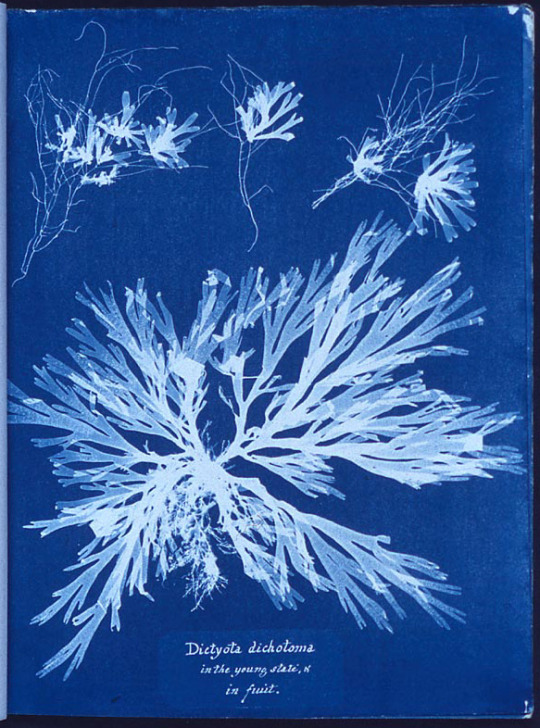


Fig. 1
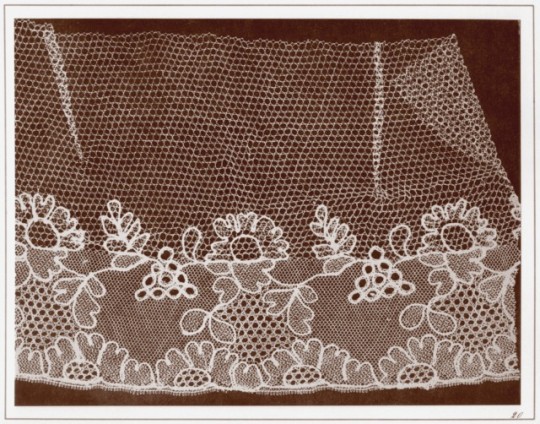


Fig. 2
When I first saw Beck’s pieces at the exhibition, I was immediately enthralled, intrigued, and a little more than confused.  He had created objects of indeterminate origin, undetectable technique and interesting form. To quote the Greek philosopher Socrates – ‘I am wise because I know one thing, that I know nothing’. I was flummoxed. What was obvious however was that Beck was playing off the light and space of the gallery itself. An innate understanding that your experience of a piece such as Linear Split (8 phases) (fig. 3), depended on your understanding of light and corresponding shadows and the way these were cast within the gallery space was obvious. Beck achieves through his work a sense of spatial awareness both in the viewer but also of the objects themselves. Shadow Strips Cascade (fig. 4) for example is a site specific piece that relies on the strip of light contributed by the architecture of the gallery itself, each photogram is made to look like a reaction to the piece directly before it. To create these Beck would place a piece of paper overtop of another light sensitive piece and with exposure to light would cause the white silhouette to remain. This to me is the epitome of the ‘specious present’ by which the cascade represents a continuous reaction to the light of the gallery space that means the artwork remains in a constant state of stasis.
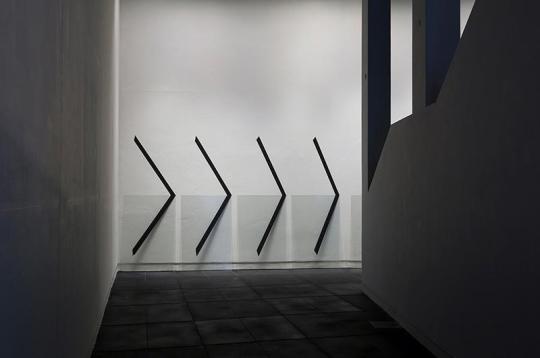


Fig. 3
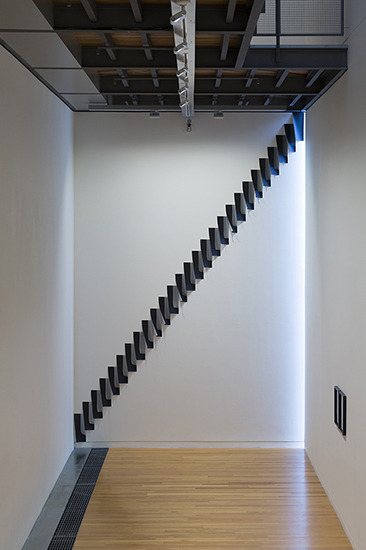


Fig. 4
Beck’s artwork itself exists in an in-between, and is a play on the duality of being, in that it becomes both photograph and painting, object and shadow, natural and manmade. As I stood in front of his work Linear Split (8 phases) my friend pointed out to me that she couldn’t decide whether the shadows projected by the glass were painted on or were in fact real shadows cast by the installation. We proceeded to spend a further ten minutes inspecting the shadows and still coming to no conclusion. Beck’s body of work intentionally plays on the exhibition space itself, causing you to question the validity of the term ‘unusable space’, what is gallery and what is installation, what is real and what is manufactured. An exhibition of Beck’s at the Galerie Luis CampaƱa utilised paint to create Invariant Shadow (fig. 5) which saw an abstraction of the idea of the realistic shadows that have previously plagued his work, to develop into a question surrounding the credibility of the work itself. The space, previously written-off as unusable in a gallery context, is transformed into a work of art through manipulation of our understanding of light sources, cast shadows and gallery space.


Fig. 5
Some of Beck’s earlier works betray the scientific facet of the medium’s ancestry. 11.35-11.55am (light drawing) (fig. 6), required knowledge of light patterns in situ at the Hamish McKay Gallery in Wellington. The abstract sundial (fig. 7) in the open window at the Govett-Brewster in New Plymouth was also time and light reliant, and echoes the use of the cyanotype by Atkins for documentary purposes rather than artistic. This piece represents a specific time of day that Beck has transformed into a continuous moment, the shadow of which is painted in black as cast by a metal rod. The metal rod embodies the ubiquitous nature of objects, by which the rod is industrial but has now been transformed into ornamental. These earlier works stand to show the development of Beck’s work from studying sources of light in relation to time, to involving space and creating philosophical, abstract objects of modernity.
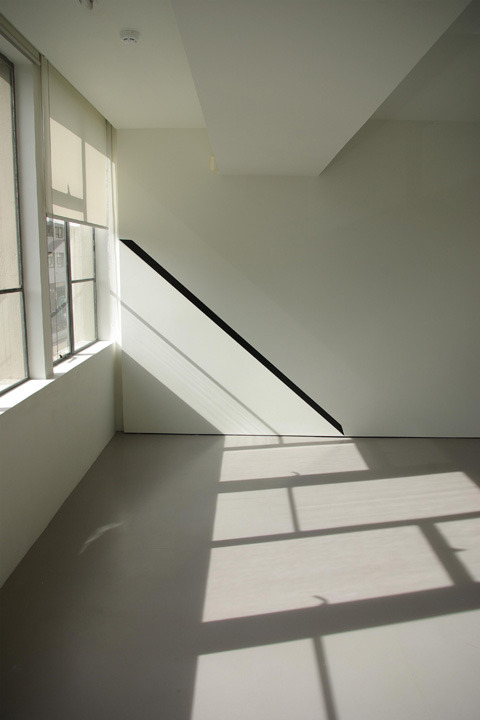


Fig. 6
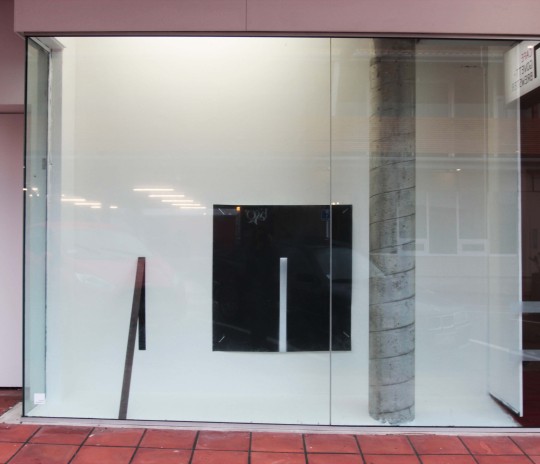


Fig. 7

When filtered through the medium of photography again, Beck’s images transform to inhibit another dimension. A dimension that is becoming more prevalent in a world of technology and social media, and the availability of that technology which encourages the institution of the snapshot photograph. The reflective surfaces of such intriguing photograms invite the viewer to use their own cameras to capture an image of the pieces such as Descending Platforms (fig. 8). The resulting photograph involves the viewer, who has thus been transformed into the object, as a representation of themselves is merged with the image of Beck’s. The viewer now also occupies the space of the image, meaning that in a way the viewer has come full circle in not just observing visual representations of the specious present, but becoming a part of it. 

Fig. 8


Wednesday, 16 September 2015

Walk

by Eleanor Lee-Duncan

If you haven’t yet seen this work, head into the Adam Art Gallery before this exhibition finishes (this Sunday the 20th!) to check it out.


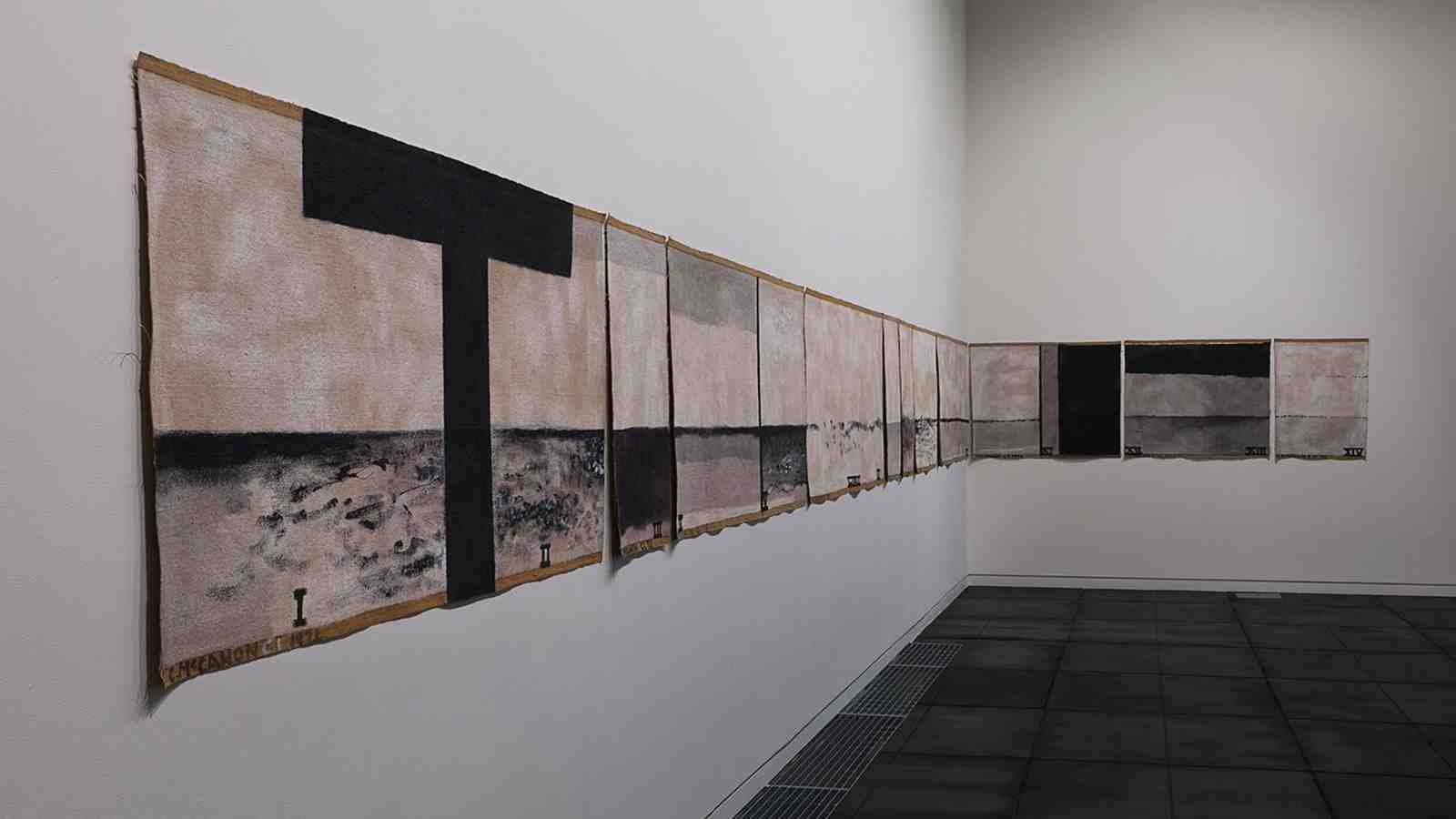
Colin McCahon, Walk (Series C) 1973, synthetic polymer paint on unstretched jute canvas, 11 panels. Collection of Museum of New Zealand Te Papa Tongarewa (photo: Shaun Waugh)

Walk (Series C), painted in 1973 is a monumental work by Colin McCahon, and seldom seen, since its purchase in recent years from a private collection by Te Papa, who graciously have loaned it to the Adam. Monochromatric, and disarming in size, it is neatly divided into 11 pieces, almost all linked by a single flowing horizon line of the sea. Hung at eye level, it keeps pace with me as I pause on each panel to contemplate. Am I keeping in step with Colin McCahon as he walked alongside this work mindfully, after each panel was complete? Did his eyes drift, slow, and then come to a still to inspect the same minute, scuffings of brush marks, and canvas threads unwinding on the edges? My eyes glide along the morse-code short and long dashes of the horizon line. 

We can view this painting as consisting of four layers of journeys or walks, which have been conceptually layered and co-exist.
The first: When we view this work, we, the viewer are compelled to walk from end to end of it in order to examine the whole work. This walk is our own journey of experiencing the painting, and keeps pace with our mental or emotional experience of the work.

The second: In doing so, we fall into step with McCahon’s own physical journey along Muriwai beach –  although in different temporal and spatial boundaries – open to the different sensory and emotive experiences of the wind, the sand, the water, the saliferous smell of the sea. After his friend James K. Baxter’s death in 1972, McCahon painted this work as an homage to the poet, perhaps thinking of him as he walked along the beach. Here, he has recorded the seascape, with the water and sky divided by a continuous thin line. McCahon reproduces this experience in his painting, walking alongside the strips of canvas while dabbing and dashing different dividing lines of land, sea, sky. Captured in different possible weather conditions, some are misty, hazy views while some are sharp, and clearly delineated.


image: www.mccahon.co.nz

The third: The walk of Christ to his execution, and the moments leading up to, and following his death. The canvas is marked with the Roman numerals 1-14, signifying the 14 Christian ‘Stations of the Cross’ – a reflective journey some people undertake around Easter, following different art works in physical spaces, or symbolic or literary anchor points in order to contemplate each experience that Jesus may have gone through. For example, the first panel has the numerals ‘I’ and ‘II’ inscribed, divided by a thick black ‘T’ of a cross. These two stations are traditionally held to be Jesus sentenced to death by crucifixion, and Jesus picking up the cross to carry it up the hill to his death. Here, the ‘T’ cross marks both the imminent method of execution, and the physical strain of the beginning of Jesus’ walk, carrying the physical weight of the instrument of his death. The only other thick black vertical section McCahon has painted is number 11, Jesus being nailed to the cross. This heavy, driving downward line brings to mind the exertion of nails being driven through Christ’s flesh to affix him to the wood. It is followed by three stacked sections of thicker grey paint, the top section black, for the panel representing the 12th and 13th stations: Jesus’ death and deposition from the cross. ‘Reading’ this panel, our eye drags downward on this canvas from the darkest stripe at the top, effectively mirroring the downward pulling of Jesus’ body from the cross.
The fourth: The spiritual journey to the afterlife of deceased Māori souls, up the West coast of Aotearoa New Zealand, past Muriwai beach and onto the sacred site of Cape Reinga, where they depart from the ancient pohutukawa tree. There, they travel down the overhanging roots of the tree, into the ocean. The spirit would surface briefly at Manawatawai (Three Kings Island) to take a final look at the landscape, occupied by the living, before continuing on to the next world. McCahon’s end panel, painted white, has a faint tracing of a line in the sky, floating parallel to the sea – perhaps a spirit taking its last journey.

Sunday, 13 September 2015

Word of the Week: Palimpsest

by Lehi Lee-Duncan

The word “Palimpsest” was coined in the mid 17th century and is derived from the Greek palin – ‘again’ – and psēstos – ‘rubbed smooth’ or ‘to scrape’. It was originally used to refer to a piece of writing material (a parchment, for example) which had been used more than once after earlier writing has been erased. More recently however, palimpsest has been used to describe something as having different layers of history – usually still visible.


Dedication of the National War Memorial Carillon, Wellington, 1932    

One recent example of the palimpsest of different histories, memories and stories, is the building and development of Wellington’s Pukeahu National War Memorial Park. Pukeahu was the original Maori place name for Mount Cook, Wellington. It can be translated to “hill-heaped-up” or “sacred hill”. Pukeahu was originally used as a pā (a hill fortification) by the Te Ati Awa tribe and much of the surrounding land was used as gardens, for food.
An 1852 watercolour by John Pearse showing two small Māori figures heading up towards the Buckle Street army barracks. Image: Alexander Turnball Library. from http://www.learnz.org.nz/memorialpark134/bg-easy-f/the-history-of-mount-cook-pukeahu


When European settlers arrived in 1840, they too saw that Pukeahu was a good site to defend, and built numerous prisons, as well as police and army barracks there. The hill was then used for a number of military purposes. Since European settlement, Pukeahu has obviously been heavily modified. The once cone-shaped hilltop has been flattened and lowered by about 30 metres, thus removing any remnants of Maori use and occupation; a metaphor for the erosion of Maori culture at the hands of white colonisers.
Archaeologists carefully excavated this gun pit at the Taranaki end of Buckle Street before the diversion road was built. From http://www.learnz.org.nz/memorialpark134/bg-easy-f/the-history-of-mount-cook-pukeahu


After the First World War, the New Zealand Government decided to build the National War Memorial on Pukeahu because of its shared and military history. In 1931, the army barracks were demolished to make way for the National Art Gallery, the Dominion Museum building and the National War Memorial Carillon.
An 1849 sketch of Wellington, done from the near where the Beehive is today. Mount Cook can be seen in the distance, with the military barracks on its peak.
Credit: Alexander Turnbull Library. Reference: A-292-071. Drawing by Thomas Bernard Collinson. 


Once the Second World War was underway, pressure was put on lower Mount Cook to enlarge its capacity for military operations, in order to accommodate the expansion of New Zealand’s forces. The Royal New Zealand Air Force occupied much of the Dominion Museum building, and underground bunkers, air raid shelters, and trenches were dug into the hill.

The main Wellington Technical College building can be seen in the centre of this photograph taken in 1934 during the construction of the National Art Gallery and Dominion Museum.
Credit: Alexander Turnbull Library. Photograph by Sydney Charles Smith. 

In recent years, in August 2012, the Government announced their plan for the Pukeahu National War Memorial Park. Their plans included putting Buckle Street underground, in order to improve the area surrounding the National War Memorial Carillon. The project began in 2013 and was finished in 2015, in order to commemorate the centenary of the ANZAC landings at Gallipoli, Turkey.
Map of Pukeahu National Memorial Park
from http://www.mch.govt.nz/pukeahu/park


It is through the layers of this shared military history, that the Government decided to place Pukeahu National War Memorial Park at the foot of Mount Cook. And it is through the palimpsest of memories and stories that serve to remind New Zealanders of the sacrifices that so many individuals and whanau have endured – from the original inhabitants of the Te Ati Awa tribe, to the men and women who fought and worked in wars both overseas and at home – in order that we do not submit ourselves and each other to more bloodshed of this kind.